
This is a retelling of Oscar Wilde’s classic story, “The Happy Prince,” first published in 1888. It’s a tale about compassion, sacrifice, and learning to see suffering that others overlook.
Unlike many children’s stories, this one has a bittersweet ending. The Happy Prince and the Swallow both die, but their acts of kindness are recognised as the most precious things in the city. This emotional complexity is part of what makes the story so powerful and memorable.
We’ve stayed true to Wilde’s beautiful language and profound themes while making the story accessible for children ages 8-12. This is a story that invites reflection on difficult questions: What does it mean to be truly happy? What matters more – how something looks or what it does? Is kindness worth it even when it costs you something?
These are big ideas. Children at this age are ready to sit with them, especially when guided by a trusted adult.
You might read this story during a quiet evening, when discussing what it means to help others, or when a child is grappling with the cost of doing the right thing.
The discussion prompts at the end can help you explore these themes together in age-appropriate ways.
High above the city, on a tall column, stood the statue of the Happy Prince.
He was covered all over with thin leaves of gold. For eyes, he had two bright sapphires. And on the hilt of his sword, a large red ruby glowed and sparkled in the sunlight.
Everyone who passed by would look up and say, “He is as beautiful as a weathervane!” Though they didn’t really know what weathervanes were for, so it wasn’t much of a compliment.
“Why can’t you be like the Happy Prince?” a mother would ask her crying child. “He never dreams of crying for anything.”
“I’m glad there is someone in the world who is quite happy,” a tired man would murmur to himself as he gazed at the wonderful statue.
The Happy Prince looked so joyful and so peaceful, standing there above the city with his golden face turned towards the sky.
But no one knew his secret.
No one knew that the Happy Prince could see everything that happened in the city below. And no one knew that when he saw what he saw, his heart – his lead heart inside his golden body – broke a little more each day.

When morning came, the swallow flew down to the river to bathe.
“Tonight I will fly to Egypt,” he said to himself. “I’ve stayed long enough.”
But when evening came and he flew back to say goodbye to the Happy Prince, he found him looking sadder than ever.
“Swallow, Swallow, little Swallow,” said the Prince, “will you stay with me for one more night?”
“My friends are waiting for me in Egypt,” said the swallow. “Tomorrow they’ll fly up the Nile and see wonderful things. I really must go.”
“Far away, across the city,” said the Prince, “I can see a young man in a tiny room. He’s trying to finish a play for the theatre, but he’s too cold to write anymore. There’s no fire in his grate, and he’s faint with hunger. His hands are blue with cold.”
“I’ll stay with you for one more night,” said the swallow, who really had a kind heart. “Shall I take him another ruby?”
“I have no more rubies,” said the Prince. “My eyes are all that I have left. They’re made of rare sapphires. Pluck out one of them and take it to him. He can sell it and buy food and firewood, and finish his play.”
“Dear Prince,” said the swallow, “I cannot do that.” And he began to weep.
“Swallow, Swallow, little Swallow,” said the Prince, “do as I ask you.”
So the swallow plucked out the Prince’s eye and flew away to the young man’s room.
It was easy to get in because there was a hole in the roof. The swallow darted through it and came into the room.
The young man had his head buried in his hands, so he didn’t hear the flutter of the bird’s wings. And when he looked up, he found the beautiful sapphire lying on his table.
“Someone must admire my work!” he cried with joy. “This is from some great admirer. Now I can finish my play!” And he looked quite happy.
The next day, the swallow flew down to the harbour. He watched the ships and thought about Egypt.
When the moon rose, he flew back to the Happy Prince.
“I’ve come to say goodbye,” he said.
“Swallow, Swallow, little Swallow,” said the Prince, “will you not stay with me one more night?”
“It’s winter,” said the swallow, “and soon the snow will be here. In Egypt, the sun is warm. My friends are building nests. Dear Prince, I must leave you, but I’ll never forget you.”
“In the square below,” said the Happy Prince, “there stands a little match-girl. She’s dropped her matches in the gutter, and they’re all spoiled. Her father will beat her if she doesn’t bring home some money, and she’s crying. She has no shoes or stockings, and her little head is bare. Pluck out my other eye and give it to her, and her father will not beat her.”
“I’ll stay with you one more night,” said the swallow, “but I cannot pluck out your eye. You would be quite blind then.”
“Swallow, Swallow, little Swallow,” said the Prince, “do as I ask you.”
So the swallow plucked out the Prince’s other eye and swooped down with it to the match-girl.
He slipped the jewel into the palm of her hand.
“What a lovely bit of glass!” cried the little girl, laughing. And she ran home, smiling.
Then the swallow came back to the Prince.
“You’re blind now,” he said, “so I will stay with you always.”
“No, little Swallow,” said the Prince, “you must go away to Egypt.”
“I will stay with you always,” said the swallow. And he settled down at the Prince’s feet.
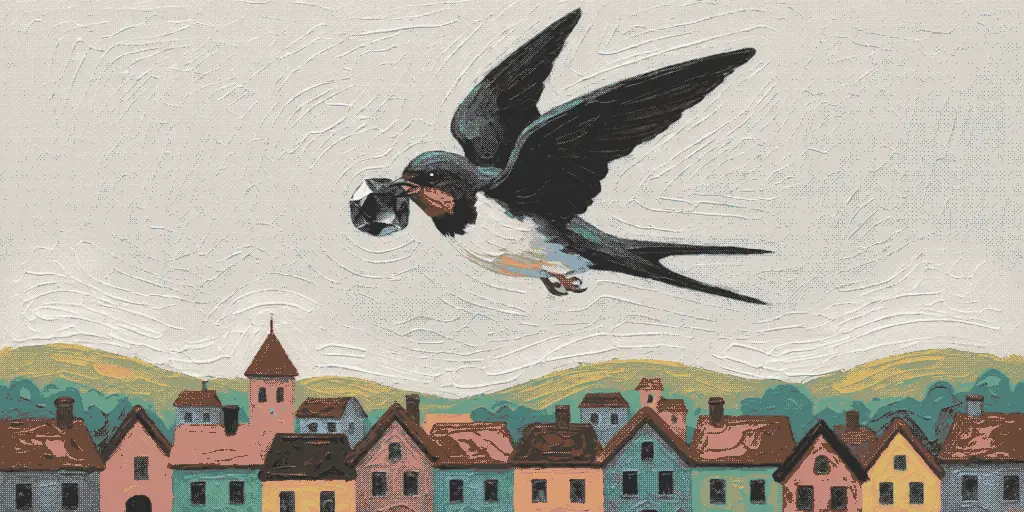
All the next day, the swallow sat on the Prince’s shoulder and told him stories of what he had seen in strange lands. He told him of Egypt, of the Sphinx, of the merchants, of the wonderful sights.
“Dear little Swallow,” said the Prince, “you tell me of marvellous things, but more marvellous than anything is the suffering of people. There’s no mystery so great as misery. Fly over my city, little Swallow, and tell me what you see.”
So the swallow flew over the great city.
He saw the rich making merry in their beautiful houses, while beggars sat at the gates.
He flew into dark lanes and saw the white faces of starving children looking out hopelessly at the black streets.
Under a bridge, two little boys were lying close together, trying to keep warm.
“How hungry we are!” they said.
“You mustn’t lie here!” shouted a watchman, and they wandered out into the rain.
The swallow flew back and told the Prince what he had seen.
“I’m covered with fine gold,” said the Prince. “You must take it off, leaf by leaf, and give it to the poor. People always think that gold can make them happy.”
Leaf by leaf, the swallow picked off the fine gold. Leaf by leaf, he brought it to the poor.
The children’s faces grew rosier. They laughed and played in the streets.
“We have bread now!” they cried.
But as the gold was taken away, the Happy Prince grew greyer and greyer. His beautiful golden covering was gone.
Then the snow came, and after the snow came the frost.
The streets looked as if they were made of silver, they were so bright and glistening. Long icicles like crystal daggers hung down from the houses.
Everyone wore furs, and the little boys wore scarlet caps and skated on the ice.
The poor little swallow grew colder and colder. He wouldn’t leave the Prince, even though he knew what was coming.
He picked up crumbs outside the baker’s door when the baker wasn’t looking. He tried to keep himself warm by flapping his wings.
But at last, he knew he was going to die.
He flew up to the Prince’s shoulder one last time.
“Goodbye, dear Prince!” he murmured. “Will you let me kiss your hand?”
“I’m glad you’re finally going to Egypt, little Swallow,” said the Prince. “You’ve stayed too long here. But you must kiss me on the lips, for I love you.”
“It’s not to Egypt that I’m going,” said the swallow. “I’m going to the House of Death. Death is the brother of Sleep, is he not?”
And he kissed the Happy Prince on the lips, and fell down dead at his feet.
At that moment, a curious crack sounded inside the statue, as if something had broken.
The fact is that the Prince’s lead heart had snapped right in two.
It was a terribly hard frost that night.
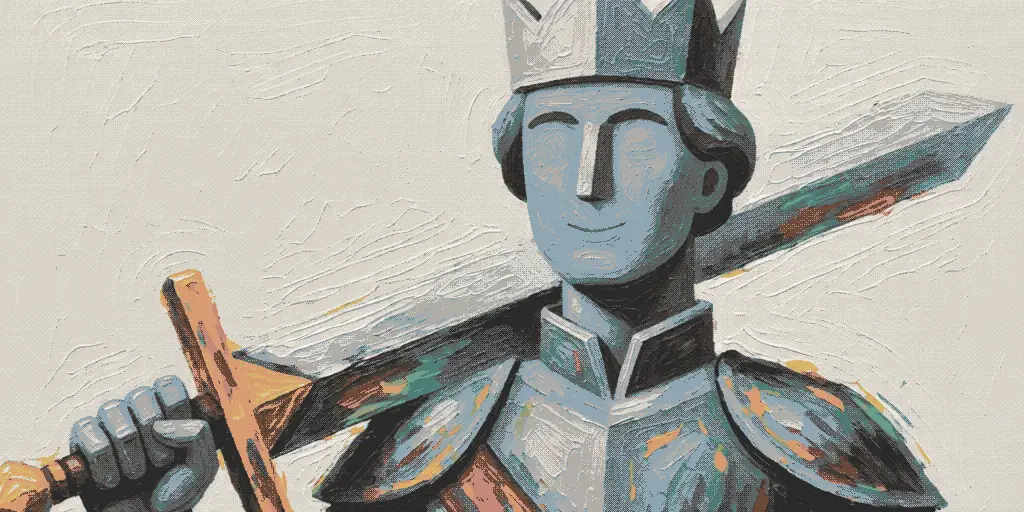
Early the next morning, the Mayor was walking through the square with some town councillors.
As they passed the statue, the Mayor looked up at it.
“Dear me! How shabby the Happy Prince looks!” he said.
“How shabby indeed!” cried the councillors, who always agreed with the Mayor.
They went closer to look at it.
“The ruby has fallen out of his sword,” said the Mayor. “His eyes are gone, and he’s no longer golden. In fact, he’s little better than a beggar!”
“Little better than a beggar!” repeated the councillors.
“And there’s actually a dead bird at his feet!” continued the Mayor. “We must really issue a proclamation that birds are not allowed to die here.”
So they pulled down the statue of the Happy Prince.
“Since he’s no longer beautiful, he’s no longer useful,” said the art teacher at the university.
They melted the statue in a furnace.
The Mayor held a meeting to decide what should be made with the metal.
“We must have another statue, of course,” he said, “and it shall be a statue of me.”
“Of me,” said each of the councillors, and they began to quarrel.
The workmen at the furnace tried to melt down the lead heart, but it wouldn’t melt. So they threw it away on a dust heap where the dead swallow was also lying.
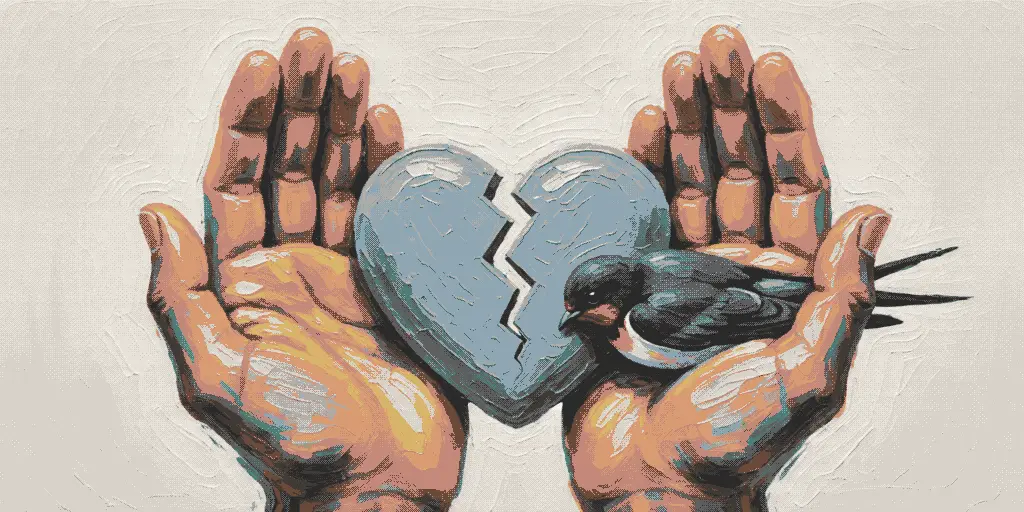
“Bring me the two most precious things in the city,” said God to one of His angels.
And the angel brought Him the lead heart and the dead bird.
“You have chosen rightly,” said God, “for in my garden of Paradise, this little bird shall sing forevermore, and in my city of gold, the Happy Prince shall praise me.”
This story might make you feel sad. That’s okay. Some of the most beautiful stories are also sad ones.
The Happy Prince and the Swallow both died. That’s hard to read. But they died after choosing to help others, after seeing suffering that everyone else ignored, after giving everything they had to make other people’s lives a little bit better.
In the end, God chose them as the most precious things in the whole city. Not the golden statue. Not the jewels. But the broken heart that loved, and the little bird who stayed.
Sometimes kindness costs us something. Sometimes doing the right thing is hard, or lonely, or makes us uncomfortable.
The Happy Prince could have stayed beautiful and golden forever. The Swallow could have flown to Egypt and been warm and happy.
But they chose differently.
They chose to see. And then they chose to give.
And that choice, the story tells us, made them the most precious things of all.
These questions can help extend the learning and process the emotional complexity of the story: